
NRW 2026: ‘All in’ for truth telling and holding racism to account
Powerful voices called for state and federal ‘truth telling’ at the National Reconciliation Week breakfast held at Optus Stadium on Wednesday.
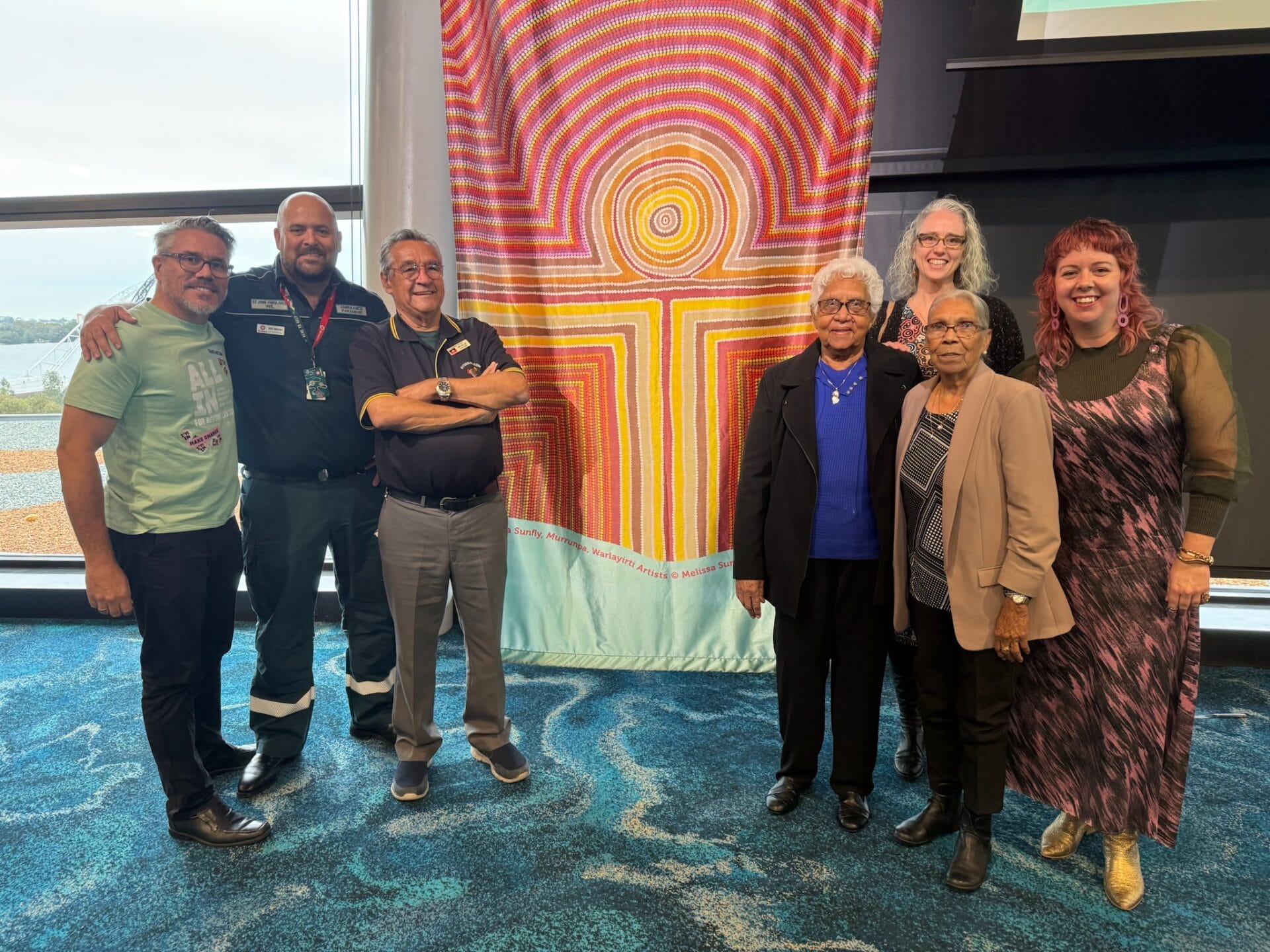
St John WA’s Elders Group, Chiefs, Reconciliation Action Plan Working Group members and Fiona & Tinesh First Nations Scholarship recipient Aidan Collier was among a 1200-strong crowd to be moved to a standing ovation by the keynote speaker.
Proud Whadjuk Noongar journalist Narelda Jacobs brought a room of Elders, Aunties, Uncles, Executives, and allies to their feet, with tears in their eyes over the wrongs of the past and present.
“The best way to address racism is with truth. WA is ready,” she began.
“…Without truth telling, reconciliation, healing, moving forward can’t happen because without understanding about how the past has brought us to the present we will be stuck in a cycle of racism, victim blaming, ignorance and indifference.”
She raised WA’s acknowledgement of the crimes committed at Wadjemup and the Pinjarra massacre, and even the Redress Scheme “as flawed as it is”.
She acknowledged Victoria’s Yoorrook Justice Commission — Australia’s first formal truth-telling body, which paved the way to a statewide treaty. And South Australia’s second election of Voices to Parliament.
“After years, decades of advocacy, momentum is building. Once again there is momentum for change,” Narelda told the crowd.
“…Racism is the scourge that the privileged don’t see and the media doesn’t report. It is in our institutions, our systems and on our streets.
“Once you see it, you can’t unsee it and you realise it’s everywhere.”
She called out the lack of charges laid against a police officer over the supermarket death of 24-year-old Warlpiri man, Kumanjayi White in Alice Springs, the booing at ANZAC day, the media debate over a viral video of a 13-year-old Aboriginal girl’s arrest at the hands of an off-duty Police officer at a Perth train station.
“Did she spark the racism debate?” Narelda questioned.
“And here’s something you won’t have heard before, it’s two 11-year-old Noongar friends walking to the park after dinner at Nans in Banksia Grove only to be pounced on by three carloads of plain clothed police.
“…They were both trembling and traumatised. It turns out police were looking for two suspects wanted for break and enters but these kids were clearly innocent.”
Narelda spoke to the grandmother for permission to tell their story: “And she said, ‘you know it’s taught the kids a valuable life lesson — they now know they have to be mindful of the colour of their skin when they’re going for a walk’.
“They’re 11.”
She called out the 11 minutes it took WA Police to respond to the bomb thrown during Perth’s Invasion Day rally, and the 11 minutes for Parliament to finally acknowledge it as an act of terrorism.
“The alleged bomb hit a Noongar girl on the leg. She had approached officers with three other girls, asking them to come and take a look. They didn’t.”
The only one to act was author Sisonke Msimang, who laid the device at police’s feet.
“Something you won’t have heard has come from a white witness… who shared with me her eyewitness account. She was on the balcony overlooking Forrest Chase, she spent two hours with police who took her statement,” Narelda said.
“Then a counselling service called her a few days later to check she was OK. Then they sent a follow up email with resources should she need them.
“Was counselling services offered to First Nations peoples who were left traumatised by the ‘what ifs’?
“…Had it not been for community vigilants would charges have even been laid? Would the incident have even been recorded?”

Pictured: Fiona & Tinesh First Nations Scholarship recipient Aidan Collier and Reconciliation Action Plan Working Group members.
Narelda called out racism over the destruction to the environment, “fears of water bankruptcy in the Kimberly”, expansion of a fossil fuel project right next to rock art at Murujuga (Burrup Peninsula).
“It’s overcrowding in homes, prisons, juvenile detention. It’s alarming rates of children in State care,” she said.
“WA has the highest rates of First Nations child removal behind the NT — higher than during the Stolen Generation.
“It was Sorry Day yesterday.”
She highlighted how token efforts to give Aboriginal people a true voice at the table — from jobs to Board rooms — has been.
“It’s undermining our confidence, reminding us we live in a colony. I could go on — it is existential.”
She called for a “seismic shift with truth”, with thousands of signatures calling for a National Truth Telling Commission on a booka (or buka) – kangaroo skin worn as a traditional cloak – being presented to Prime Minister Anthony Albanese in Canberra and also one to the Governor of Western Australia, His Excellency the Honourable Chris Dawson AC APM wanting a local truth telling process formalised by WA Parliament.
She called for WA to the first to change the date of Australia Day, to applause from the crowd.
“Once Australians understand the past it has to help folks the present and the future.
“Surely then we will stop hearing that thing we hear all too often, ‘Hmm Aboriginal people really to do more to help themselves’,” she said with a grimace.
“…We need you to show up, we need you to be antiracist.
“We need you to be all in, all the time.”
Other earlier speakers included Welcome to Country by Dr Richard Walley, the Premier Roger Cook, Reconciliation WA Aboriginal Co-Chair Nolan Hunter and his excellency Chris Dawson.
June Oscar also spoke on stage about the ‘Wiyi Yani U Thangani Report’ for First Nations Gender Justice, which captured 2000 female First Nations voices across Australia and asking for an Inquiry into Racism.
She will be conducting a sold-out evening of truth-telling, leadership, and reflection with her Reconciliation Memoirs at Hackett Hall WA Museum Boola Bardip on Thursday night.
To watch the full free telecast visit SBS on Demand.